The Origin Story, Reassembled
It makes more sense if you start in 2017.
Natalie Cressman and Ian Faquini are onstage at Hardly Strictly Bluegrass – 30 minutes, a smaller ensemble slot. A couple of originals, a few covers, nothing overstated. Just two musicians beginning to understand what happens when their instincts line up in real time.
That’s the version that moves forward.
Go back a year.
2016 – Northern California, redwoods, an adults-only camp that had evolved into a space for musicians. That’s where Cressman and Faquini meet – at least in the way that counts. They start playing together there, casually at first, then with intention. Something clicks. Not dramatic. Just… familiar.
Then the timeline slips.
Details surface. Conversations circle back. Small overlaps that don’t quite make sense until they do.
They had been there before.
Same place. Same camp. As kids – seven years old, long before it became a destination for adult musicians. Back when it was karate, crafts, unstructured days. Their parents had brought them there separately, unknowingly placing them in the same orbit.
They don’t have a shared memory of it.
But the fact remains.
So what feels like a beginning in 2016 starts to look more like a continuation. And by the time they step onstage in 2017, they’re not just starting something – they’re stepping into it.
Not Quite a Duo
Calling them a duo is accurate.
It’s also incomplete.
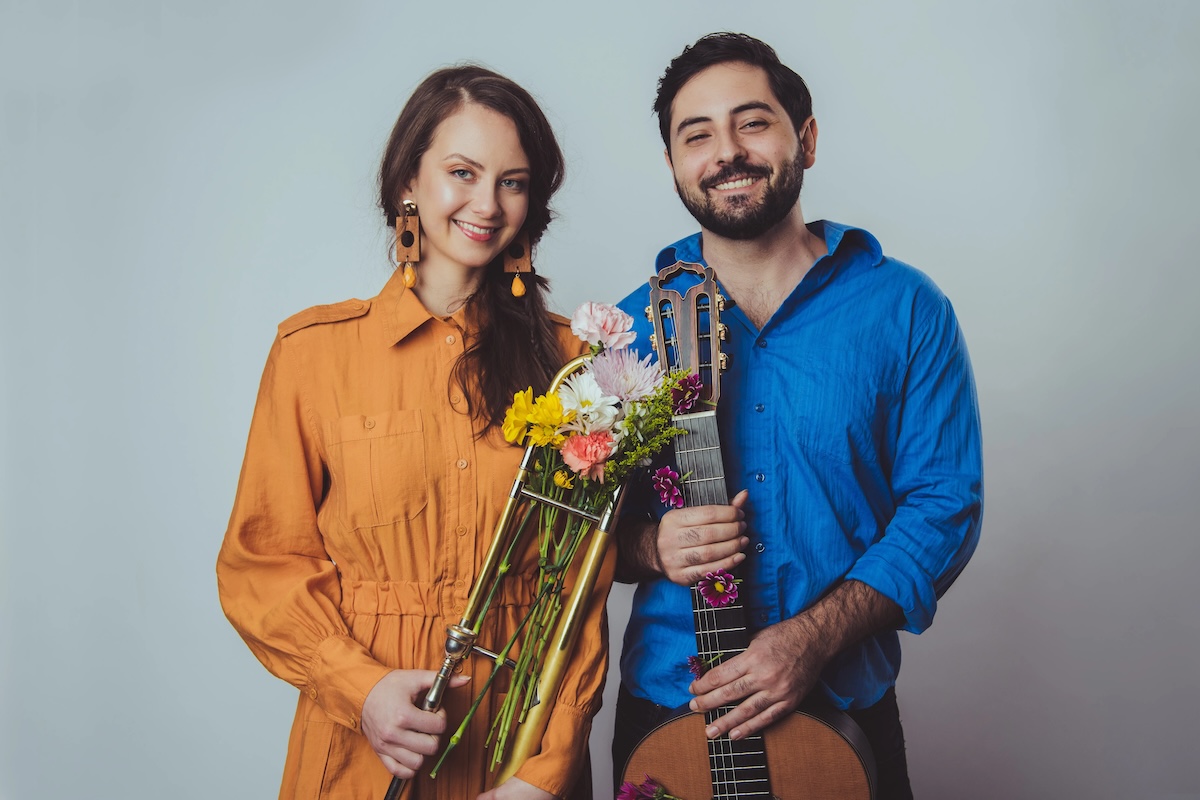
Across four albums and international touring – spanning the U.S., Brazil, Europe, and Japan – Cressman and Faquini have built something that behaves less like a pairing and more like a single, evolving system.
She’s a trombonist, vocalist, and songwriter out of San Francisco. He’s a composer, guitarist, and singer from Brasília, raised in part in the Bay Area. Together, they’ve honed a shared language that pulls from the Brazilian songbook, American jazz, Impressionism, and modern songcraft that refuses to sit still.
A Sound That Outgrows Its Frame
On paper, it’s minimal: trombone, acoustic guitar, two voices.
What comes out doesn’t stay that way.
Their arrangements are richly layered – two-part harmonies wrapped tightly around Brazilian-accented phrasing, guitar carrying rhythm and harmony at once, trombone shifting between melody and atmosphere. The result is a sound that feels orchestrated far beyond its size.
Not bigger for effect.
Just complete.
Language, Rhythm, and Daily Life
Portuguese often leads, but it doesn’t stay alone. English and French move in and out, depending on where a song wants to land.
The foundation, though, is unmistakable.
Brazilian rhythm – not as reference, but as core. The groove, the phrasing, the feel underneath everything. It comes from time spent there, not just study – music absorbed as part of daily life.
From there, the palette expands: jazz phrasing, folk traditions, harmonic exploration, and lyrics that stay close to human scale – love, loss, the texture of everyday experience.
Even their more conceptual work follows that thread – a reimagining of The Nutcracker through Brazilian rhythmic structure that plays less like a departure than a translation.
A Setlist That Listens Back
They come in with a plan.
They're not zealots about keeping it.
The duo format gives them room to move – across originals, Brazilian repertoire, and, when the moment calls for it, into unexpected territory: The Beatles, the Grateful Dead, Steve Winwood.
They read the room. Follow the energy. Let the set bend.
The performance becomes a conversation.
And if that conversation turns physical – if people feel like moving – no one onstage is going to stop it.
Wellfleet, By Way of Alignment
This run – upstate New York, Connecticut, now Wellfleet – came together less like a traditional tour and more like a series of aligned moments.
The right invitation. The right timing.
And now they arrive at Wellfleet Preservation Hall carrying all of it – California, New York, Brazil, years of separate study and shared experience – held together in a form that doesn’t quite lock into place.
What to Expect
Don’t expect a fixed program.
Expect something assembled in real time: languages shifting, influences folding into each other, songs stretching just past where they’re supposed to end.
Expect harmonies that land closer than you think.
And somewhere in it, whether you can place it or not, the sense that what you’re hearing didn’t start here.