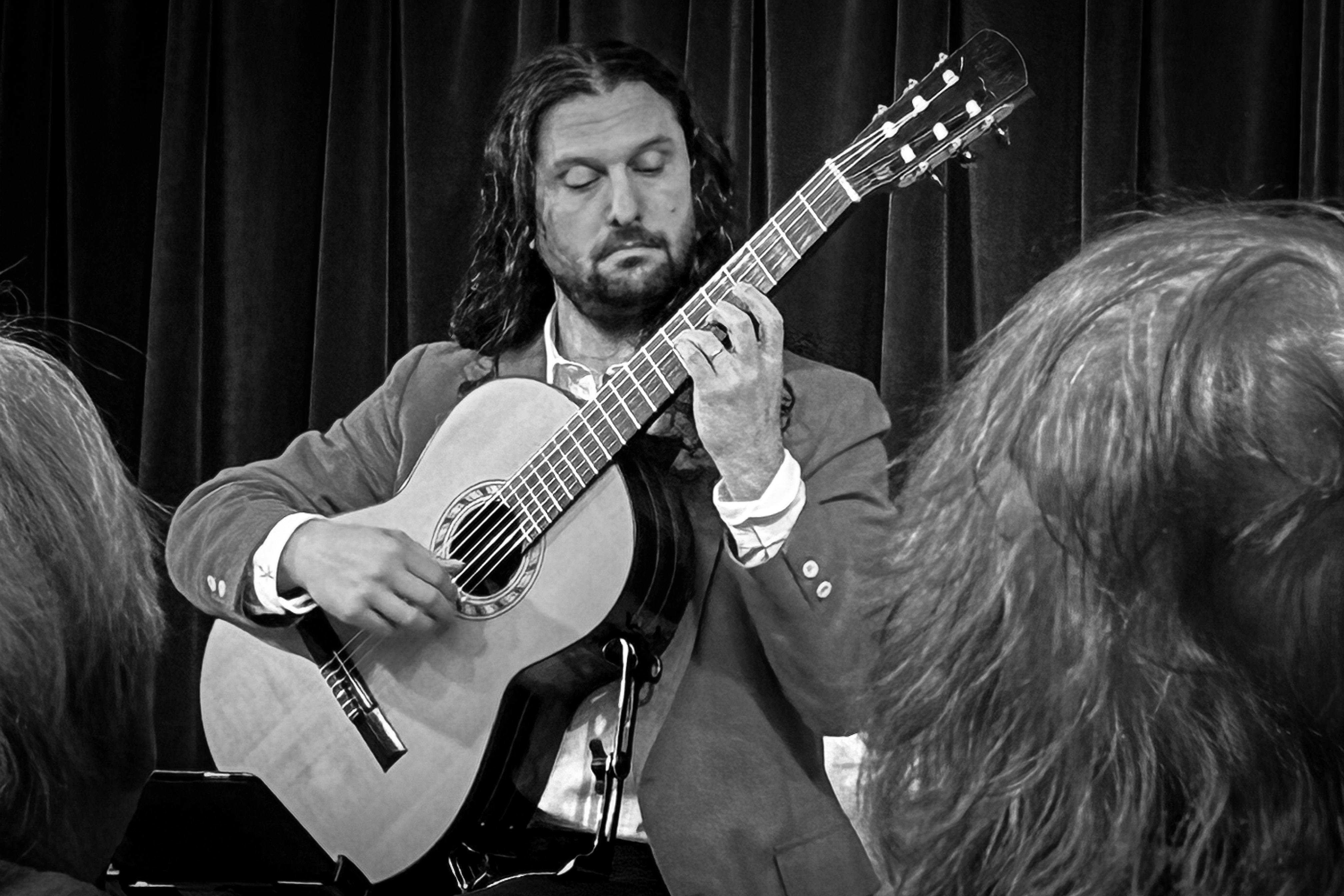
Award-winning classical guitarist and composer Aaron Largen-Caplan (and proud Cherry Creek High School Hall of Famer) is touring his new album, GUITARIST AMERICA 250: REVOLUTIONARIES & ROCKSTARS. The program spans The Star-Spangled Banner, West Side Story, Battle Hymn of the Republic, and even a bit of John Cage, interwoven with spoken word elements.
For the sake of laying a foundation before we climb the radio tower (because that’s where the fun is), let’s meet Aaron: Colorado native, outdoorsman & athlete in his youth, who picked up the electric guitar at about 11 and made his way playing along with Van Halen, The Doors, and maybe even some Paul Simon CDs. In a late spring Spanish class his sophomore year, he came across Andres Segovia’s famous lines from Asturias (Leyenda) by Isaac Albéniz quoted by Krieger and The Doors on Spanish Caravan. Smart enough to figure out that they were quoting him and not the other way around, but not knowing it was originally for piano, he was turned to the classical light.
Painting cupboards all summer to save money, he bought himself a classical guitar and found a teacher to put him on the road. Soon he was listening to Beethoven regularly and, after playing some for his brother one day in the car, found a key to his personal playing in a simple take his brother gave him about the movements he just heard “that’s not classical, classical is boring – and that wasn’t boring.”
It seems like that is the same approach to classical guitar Aaron’s still taking – he’s not interested in sanding down complexity, but he is committed to making sure it never feels like work for the listener. He’ll also cite his time in Speech and Debate with adding to that: yes, you have to win the debate and you’re seldom able to do that with boredom and dry complexity. Voila, the transitive property strikes again. The guitar as form has been refined from Rock & Roll to Classical and the performer’s stage presence the verbal and the cerebral to the aural and emotional. Load up for bear, the time is nigh.
Aaron finds himself in Boston for a short stint at BU before enrolling in, and eventually graduating from, the New England Conservatory. Not only does he secure the education that grants him his trade, and the opportunity to gig regularly (both of which are true), this is also when he meets, and spends seven years studying privately with, what seems to be his most profound teacher and mentor: Dmitry Goryachev.
On the third floor of a triple decker tenement in Dorchester, Aaron studied with Goryachev and learned how to be with his instrument. And while Aaron did not explicitly tie this learning to be to the magic we’re about to discover on our climb through his antennae’s metal geometry growing out of this foundation, I would say the radio was fired up and tuned at about that time. All that was left was to be found working when the frequency came calling from without.
Magical Black
With the Spanish guitar as the root instrument for both classic and flamenco, there are practical similarities before the philosophical or temperamental differences begin to emerge en masse. Classical players often pursue an ideal sound, something they can reliably produce through hand position, touch, even nail length. Success, in that relationship between player and music, can be measured by fidelity to the source material.
Flamenco is concerned less with strict adherence and more with the living exchange between dancer, singer, and the guitarist’s playing. Interpretation opens up. The Spanish roots and traditions themselves are idiosyncratic, and the guitarist leans into percussion and rhythm as drivers, rather than space and composition. Aaron intimates that the animating spirit of flamenco, when the player is captured, overtaken by something outside themselves compelling their hands, the duende, as Federico García Lorca calls it, is essential to pure flamenco. And yet, he suggests, it is also available in classical guitar, especially in the works of one of his heroes, John Cage.
When considering how Aaron seems to have come across this phenomenon, the order of his experiences does offer the benefit of the doubt. First he immerses himself in classical and the pure skill and adherence to proper execution. Then, widening the lens to include Spanish & flamenco while also equipped with form & ability as muscle memory, able to perform without thought but by feel, he’s accessible to that animating spirit, available to duende. I’ll bite.
But we’re not done; we need to complete the climb the to the peak of the receiver wire, where the wind will certainly wobble you, If classical addresses the relationship between the instrument and the written music, and flamenco is concerned less with skill than the encounter’s chemistry between the dancer, the singer, and the guitarist’s playing, when Indian music is introduced, the Rasa rises up, concerning itself with the interplay not only of these available elements but now will incorporate the audience as participant.
Rasa translates as “flavor” or “taste” or “juice.” It IS the emotional or spiritual state that passes between the audience and the performer. The nine traditional rasas in Indian aesthetic theory: love, humor, sorrow, anger, heroism, fear, disgust, wonder, and peace/transcendence. When our man Aaron invokes the concept of Magical Black, he’s getting to a place where the performer, the performance, and the audience’s collective frequency (likely established through engagement & experience) align to the ultimate end of what can almost be described as molecular dissolve: all of the atomic points dissipate, leaving only the realized energy of the music, itself now greater than the sum of its, many parts.
Knowing this is Aaron Largen-Caplan’s goal, are you moved?
We will see you for seance this Friday night at 7p at the Wellfleet Preservation Hall.
•••
Listen to Aaron’s music on Spotify, READ more about his work, especially his New Lullaby Project HERE.