What a Rockstone may be isn’t any more or less clear than where this song sits in your ear … jazz is the first burst (those are brushes right?) but it’s short-lived before there’s an invasion of strings that range from mandolin (or is it a fiddle?) to baritone guitar. Spare, light kisses from the piano appear like a reflection in a house of mirrors between lead guitar lines and then the backing vocals are upon you like an apparition, over one shoulder, a long-fingered hand wrapping around on your other.
Subversively easy to play on repeat, the instrumentation of the song misleads with a borderline orchestral arrangement that expands over the 5-minute play-time. On the surface, there’s nothing complicated about Rockstone - are there any words with more than two-syllables? But now you can approach the Hemingway (or even Lennon) weight-through-simplicity. The pony can be dug even deeper when the meaning of the words aren’t as satisfying as the act of repeating them.
Rockstone’s a foot-tapper. Listening to it a couple times through, it bops, it’s got elegant, angelic backing vocals, and it’s immediately singable even if you don’t know the words (that is to say, it’s hum-able). The musicians sound more like they’re pulling something from the instrument than pushing something through it - sculpting v painting. Maybe there’s a mandolin, maybe there’s a fiddle, fuckit, maybe that’s a harp - a tone gets into your ear and will bing-tingaling around like a helium balloon - ricocheting high off the wall, then the ceiling, then the ceiling again before it hits the other wall, the ribbon tethered to the acoustic guitar anchored, its feet … on the ground.
Not to be overlooked: Rockstone cleans up real nice on the album cut. Keb Hutchins’ baritone guitar lines run through the solo, finding you on the other side of that initial jazz glimpse and the orchestral arrangements to douse you in Gene Vincent or Roy Orbison or Link Wray. You open your eyes expecting to see a Bill Haley record spinning on the jukebox at Arnold’s. It’s a timeless stroke that you may not have heard this side of Badalamenti’s score for Twin Peaks.
If the studio version is foot-tappable, the barroom experience is foot-stomppable.
Innumerable versions of the song have passed through speakers from Dennis to Truro since it hit heavy rotation in Ayala’s live performances in the front-nine side of 2025 (if there was a set list, Rockstone would hold court in the caboose … but there’s no setlist). Written roughly 20 years ago, his wife, singer Melissa (the aforementioned angelic vocalist), performed it as a blues tune over however many iterations through the annals.
The current tune is/was mostly a show closer that escalates into a drunken sing along complete with call & response and borderline skat lyrics (more jazz!). But it also plays far closer to this album( depending on the room … looking at you Barley Neck): calmer, the blissful exhaustion coming through, crystal clear with a foregone, forlorn, honest grin.
You can field the lyrics straight up - for about two, maybe four lines. Then they drift in on a slow current of phrases delivered with Ayala’s truly distinct, deep, soulful, get-out-the-towels (you know which towels), voice. Verses leave remnants more tonal than lingual. Watch the “Get Back” writing session in the Beatles doc, they come together through sonance before lyrics - that’s how Rockstone can leave you: pleased, humming the phonic rhythm and the rise & fall before the pictures in the words emerge.
But when you do pick your way through those words, there’s true, maybe resigned but, honest joy in three acts. Ye olde lonely Rockstone (thinking Toshiro Mifune or maybeSt Francis), feet firmly planted, looking always ahead. Does the rockstone tire? Naturally. Does his mind spot, does his voice fail? Does he need to rest? Yes. But while there may be rest, there is no quit, there is only fight and the move forward. That’s accepted, that’s the warrior-samouri - it’s the responsibility, strike that, it’s the vocation of the Rockstone.
The Rockstone’s forum, the field of battle is as old as time, ancient, regal but simple; it comprises the ultimate reaches of achievement, the Garden of Eden, and the gorgeous, barren edges of existence all at once - pictures drawn by Ayn Rand with Cormac McCarthy’s stubby pencils. Powered by a nameless force, the Rockstone is unphased even when almost blind by the sun’s absence, he sees magnificent beauty in things even then. There’s beauty in the whole of this life. Possessed by who-knows-what to keep moving (the Rockstone, famously impervious to moss!) on a mission to a could-be-nowhere, he entertains no thoughts of course correction, no matter the venue to which he’s been assigned. He’s a vessel to fulfill a destiny. This small town venue is his claim, this here is home now. When it’s time to rest, this is the kingdom for his repose.
Finally the inevitable: exhausted from the endless waging of whatever war, from the futile search for whichever art's elusive satisfaction, the Rockstone accepts the altar of self-sacrifice. Slowly he approaches, saddened by not having realized what was inside him, having not reached his own personal lighthouse through the fog. He will submit.
His head hung, forehead pressed to the cold marble awaiting the final strike, he suddenly snaps upright, his inner Jordan Belfort erupts “I’m not leavin .. I’M NOT FUCKIN LEAVIN, THE SHOW GOES ON!” He can't bring himself to desert. The Rockstone knows he’s close, far too close to quit, he knows he’s been on the right path, and he knows he’s overdue to pan the gold, to strike the oil, to touch the lighthouse through the fog. He gathers his robes and again takes to the trail, like Caine in Kung-Fu.
Even in his refusal to give over and succumb to this despair, however, he knows he may be kidding himself. Sure, he continues on, he defies the fates and thumbs his nose at the odds, but he knows, deep down, this drive, this wandering toward eternal bliss, may itself be the only bliss he finds. And with this he’s at peace, willing to be released to it. But it must take him, he will not forfeit his turn.
And, on one of those few days when he allows himself to rest, he’ll look back and take solace in the fact that he is Rockstone, and would not give up what he knows is his devine decree, he takes pride that it is, in fact, on him. So he closes his eyes after the light has gone out of the sky, he appeals to the gods above and the sea & the moon, to rest his soul, “rest my soul, it’s on me, Rockstone.”
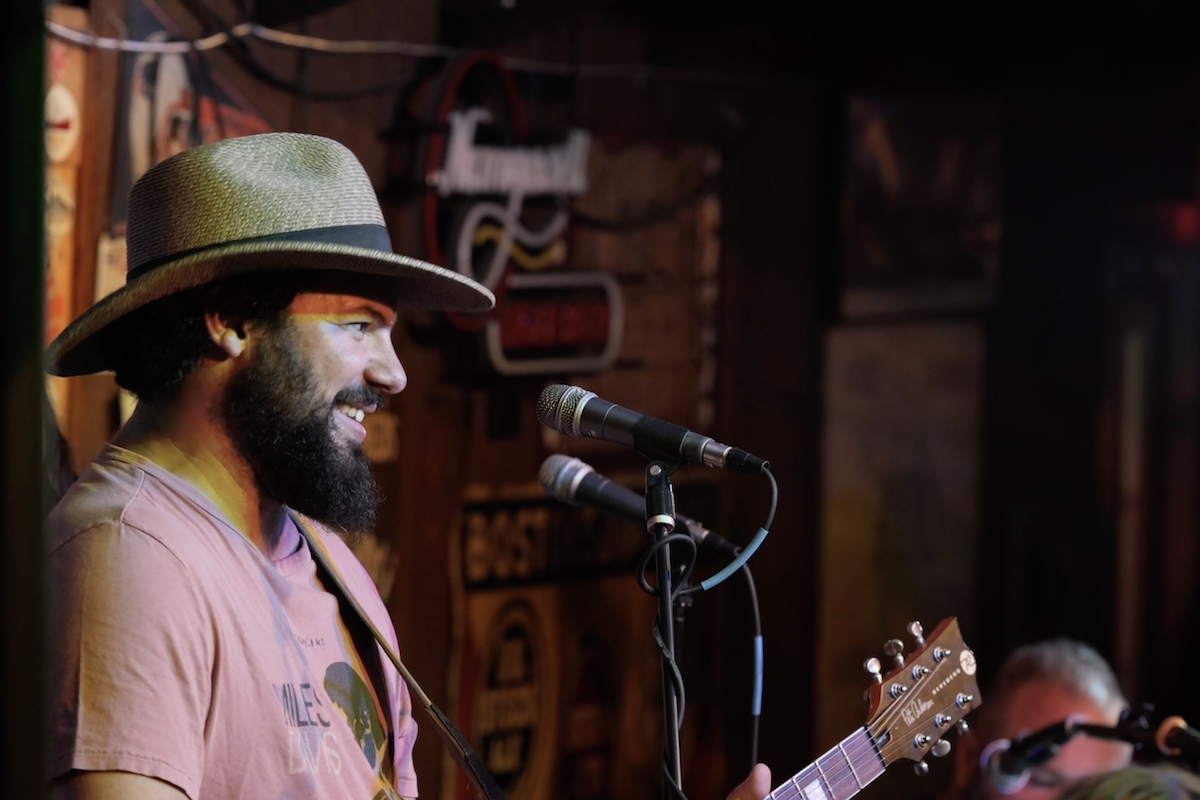
Personnel:
Josh Ayala ( singer/songwriter, acoustic guitar)
Jon Evans ( bass, background vocals)
Keb Hutchings (mandolin, baritone guitar , background vocals)
George Smith (grand piano)
Brad Conant (drums)
Melissa Ayala (background vocals)